







| About the Journal | For Contributors | Browse Archives |
KJCLS
- KCI(Korea Citation Index)
- DOI(CrossRef)
- DOI(CrossCheck)
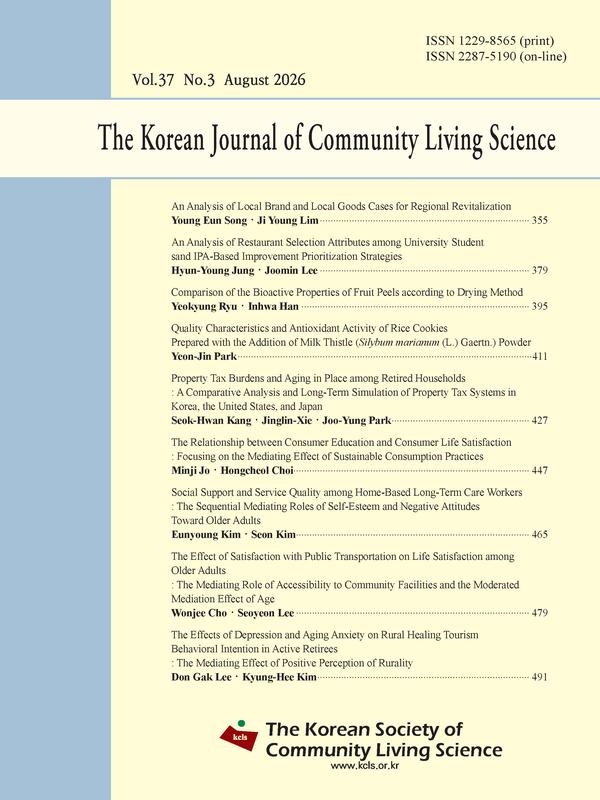
The Korean Journal of Community Living Science
ISSN : 1229-8565 (Print) / 2287-5190 (Online)
KJCLS
- KCI(Korea Citation Index)
- DOI(CrossRef)
- DOI(CrossCheck)
The Korean Journal of Community Living Science
ISSN : 1229-8565 (Print) / 2287-5190 (Online)
Research Ethics Regulations
Korean Society of Community Living Science (KSCLS)
(Enacted on Feb.1, 2008)
(Amended on Apr.3, 2026)
Chapter 1 General Rules
Article 1 Purpose
These regulations seek the sound development of research by establishing a control system of process to promote strict and ethical research so that human dignity and values or social joint ethics are not damaged by research related to the Korean Society of Community Living Science (hereinafter referred to as "the Society").
Article 2 (Object and Scope of Application)
- 1. Object: these regulations shall apply to all members of the Society.
- 2. Scope: if there is no other special regulation, these regulations shall be observed with regard to the establishment of research ethics and verification of research integrity.
Chapter 2 Research-related Ethics Regulations
Article 1 Ethics Regulations on Researchers
- 1. Researchers shall be honest when conducting research.
- 2. Researchers shall do their best to prevent illegalities, such as forgery, falsification, plagiarism, duplicate publication, and unreasonable author display.
- 3. Definition of Terms
- (1) Forgery: generating nonexistent data or findings and recording or reporting them.
- (2) Falsification: reporting research data, equipment or processes contradictory to the truth by fabricating, changing or deleting and thus distorting them.
- (3) Plagiarism: stealing ideas, processes, results or records without authorization.
- (4) Duplicate Publication: double-publishing one finding in different academic journals.
- (5) Unreasonable Author Display: disqualifying a person who contributed to research contents or results in scientific or technical terms for authorship without just reason, or qualifying a person who did not contribute in scientific or technical terms for the reason of gratitude or honorable treatment.
- 4. Authorship
- (1) Substantial contributions to the conception or design of the work; or the acquisition, analysis, or interpretation of data for the work
- (2) Drafting the work or revising it critically for important intellectual content
- (3) Final approval of the version to be published
- (4) Agreement to be accountable for all aspects of the work in ensuring that questions related to the accuracy or integrity of any part of the work are appropriately investigated and resolved
- 5. Citation and Reference
- (1) When citing academic writings, an author shall ensure accuracy and make clear their sources. Data privately obtained may be cited only after receiving consent from a researcher who offered the same.
- (2) When citing or referring to others' writings, the author shall make clear the citation or reference, and distinguish his /her original opinions or interpretations and other researchers’ previous studies.
- (3) If writings do not contribute much to the author’s study, thanks shall be expressed for them in footnotes, the introduction, acknowledgments, etc.
- 6. Prevention of Conflict of Interest
The Chair of the Research Ethics Committee shall ensure that, when a committee member submits a manuscript to the journal, the review process is not influenced by appointing external reviewers.
- (1) When a committee member submits a manuscript, reviewers shall be selected excluding the submitting member.
- (2) Researchers affiliated with the same institution as the author shall be excluded from serving as reviewers.
- 7. Prevention of Research Misconduct Involving Related Co-authors
- (1) “Related persons” refer to cases in which a researcher involves a minor (under the age of 19) or family members (e.g., spouse, children, or relatives within the fourth degree of kinship) in research participation or co-authorship.
- (2) To prevent research misconduct involving related co-authors, personal information shall be provided in advance. If research misconduct is confirmed, submission shall be prohibited.
- (3) Other matters shall comply with the Guidelines for Preventing Improper Authorship in Research Papers (revised April 10, 2020).
- 8. Ethical Use of Generative Artificial Intelligence (AI)
- (1) Authors may use generative artificial intelligence (AI) technologies as an auxiliary tool in the preparation of manuscripts. However, such use shall be limited to improving readability, enhancing language expression, translation, and summarization. The use of AI for substantive content creation—such as generating, modifying, or synthesizing text, figures, or images that constitute the core research content—is restricted.
- (2) Authors must clearly disclose the purpose and scope of AI use. In particular, when AI is used for content generation, translation, summarization, or language improvement, such use shall be indicated at an appropriate place within the manuscript.
- (3) Generative AI is a research assistance tool and shall not be recognized as an author. Authors bear full responsibility for the accuracy, originality, and integrity of all AI-assisted content. Authors must directly verify the factual accuracy of any content, references, data, or citations suggested or generated by AI.
- (4) When inputting research data or sensitive personal information into AI systems, authors shall recognize the risks associated with external transmission and storage and take appropriate protective measures in advance. Authors must comply with the security guidelines of their affiliated institutions and ensure the protection of research subjects’ personal information.
- (5) Failure to clearly disclose the use of generative AI, or violation of these provisions, may result in rejection of the manuscript during the review process or retraction after publication.
Article 2 Ethics Regulations on Editors and Examiners
- 1. Editors shall be solely responsible for deciding whether to publish submitted manuscripts.
- 2. Selection of ExaminersEditors shall refer submitted manuscripts to examiners with professional knowledge in relevant fields and objective and fair judgment ability.
- 3. Roles of Examiners
An examiner shall review the manuscript involved faithfully and fairly on an objective basis within the period prescribed by the examination regulations according to the manuscript submission regulations, inform the editors of the results, and immediately report research misconduct, if any, to the editors (Editorial Board).
- 4. Resignation of Examiners
When considering themselves to be unqualified for evaluating a manuscript, examiners shall report their intention to resign to the editors (Editorial Board) immediately.
- 5. Objectivity of Examination An examiner shall review the manuscript involved fairly on an objective basis, regardless of their personal academic beliefs or relationship to its author. The examiner shall not reject the manuscript without specifying the grounds or because the paper does not agree with his/her point of view or interpretation, nor shall they evaluate the manuscript without reading the document properly.
- 6. Consideration for Author The examiner shall respect the personality and independence of the author as a professional intellectual, and evaluate the manuscript as politely and softly as possible without using contemptuous or insulting expressions.
- 7. Confidentiality
Editors and examiners shall keep all information in manuscripts thoroughly secret, and not disclose or cite any of the information before the journal involved is published.
Chapter 3 Establishment of Research Ethics Committee
Article 1 Composition of Research Ethics Committee
- 1. A Research Ethics Committee (hereinafter referred to as "the Committee") shall be established within the Society to deliberate on matters on research ethics.
- 2. The Committee shall consist of ten or fewer commissioners, including Vice President, General Affairs Director, Ethics Director, Academics Director, and Editing Director.
- 3. The Chairperson shall hold the additional post of Ethics Director.
- 4. Each commissioner shall be recommended and appointed by the Chairperson and President for a two-year term, which may be extended for the next two years.
- 5. No person who has direct interest in the investigation involved shall be a commissioner.
Article 2 Operation of Research Ethics Committee
- 1. Committee meetings shall be convened by the Chairperson, when requested or recognized by the President as necessary.
- 2. Committee meetings shall be opened by the presence of the majority of members on the register and decided by the majority of present commissioners; however, a power of attorney is recognized as presence at the meeting, while being granted no right to vote.
- 3. The Chairperson may ask the chief investigator to submit data or reports, if needed, for deliberation.
- 4. Commissioners shall keep all matters related to deliberations secret.
Article 3 Functions of Research Ethics Committee
The Committee shall deliberate on the following matters.
- 1. Research ethics problems raised about research papers, outlines, reports, etc. related to the Society
- 2. Research ethics education
- 3. Safety, privacy and compensation for loss
- 4. Investigation of research misconducts
- 5. Research ethics issues referred by the chief investigator of a research project for deliberation
- 6. Research ethics issues referred by other chairpersons for deliberation.
Chapter 4 Enforcement of Ethics Regulations
Article 1 Misconduct Report and Acceptance Thereof
An informant may report misconduct to the Secretariat or the Editorial Board with every possible means on his/her own real name; however, anonymous reports require the submission of a research paper title (or research project title) and specific misconduct details, including evidence.
Article 2 Misconduct Investigation
- 1. If there is considerable suspicion or a specific report, the Committee shall investigate whether there is any misconduct or not.
- 2. The Chairperson may let the Editorial Board make a preliminary investigation in consultation with the Society's President.
- 3. The Committee may ask an informant, a suspect, a witness, and a testifier to attend and provide testimony. In such cases, the suspect must meet the request.
- 4. The Committee may ask the suspect to submit data, and confiscate, store the research data involved in order to preserve evidence after the approval of the research institution involved.
Article 3 Assurance of Objection and Pleading
The Committee shall assure both an informant and a suspect of the equal opportunities for testimony, objection and counterargument, and inform them of the relevant procedures in advance.
Article 4 Judgment
- 1. The Committee shall decide the details and procedures of the investigation based on objection or counterargument.
- 2. The Committee shall judge the suspect's act related to investigation as research misconduct, by the majority presence of the commissioners on the register and by the 2/3 agreement of the commissioners present.
Article 5 Measures after Judgment
- 1. Once an incident is judged to be research misconduct, the following two or more sanctions may be imposed.
- (1) Cancellation of publishing the research paper involved
- (2) Announcement of the cancellation in the Society's homepage and academic journal
- (3) Disqualification or suspension of membership
- (4) Notification of the organizations concerned
- (5) Other proper measures
- 2. The announcement in Section 1, No.(2) shall include the author's name, research paper title, Vol. No., cancellation date, reasons for cancellation, etc.
- 3. The Committee shall determine the period of disqualification or discontinuation in Section 1, No.(3).
- 4. The Committee may disqualify or suspend the membership of a person who made a false report or distributed false facts by intention or great negligence with regard to the Society's research ethics.
Article 6 Notification of Results
The Chairperson shall draw up the Committee's decision in writing and inform the same without hesitation to the persons concerned.
Article 7 Reinvestigation
Demurring to the Committee's decision, the suspect or informant may ask the Committee for reinvestigation in writing within fourteen days from the date of receiving the notification set forth in Article 6.
Article 8 Follow-up Measures, Including Rehabilitation
If the investigation confirms that there was no research misconduct, the Committee may appropriate follow-up measures to recover the honor of the suspect.
Article 9 Storage and Revelation of Records
- 1. The documents related to the investigation shall be stored for five years from the date of investigation termination.
- 2. After the judgment, the results shall be reported to the Standing Board of Directors of the Society.
- 3. When there is a possible disadvantage to the persons concerned, the Committee may decide not to disclose information regarding identity, such as the list of informants, investigators, witnesses, testifiers, and persons involved in counseling.
Article 10 Right to Protection and Confidentiality of Informant and Suspect
- 1. An informant's identity shall not be revealed directly or indirectly in any case.
- 2. Care shall be taken to protect a suspect's honor and rights until verification of the misconduct is completed.
- 3. All matters regarding the investigation shall be kept secret, and the persons involved in the investigation directly or indirectly shall not divulge any information obtained during the course of the investigation. The information may be disclosed after resolution of the issue by the Committee, only if there is any reasonable necessity for disclosure.
Article 11
The Society's members and persons related to research activities shall observe "the Ethics Programs for Scientific and Technical Professions," which was jointly enacted and promulgated by the Korean Federation of Science & Technology Societies (KOFST), the Korean Academy of Science and Technology (KAST), the Korea Engineering Academy (KEA), and the Korean National Commission for UNESCO 4. 20. on April 20, 2007.
Addenda
(Date of Enforcement) These regulations shall take effect on April 3, 2026, the date of approval by the Board of Directors.
The Korean Journal of Community Living Science
Most Read

ⓒ 2016 The Korean Society of Community Living Science. All rights reserved.
The Korean Society of Community Living Science
Tel: 010-3843-8109
Web: https://kcls.jams.or.kr
E-mail: kcls08@hanmail.net, kcls06@hanmail.net